 How-to
Old Pet Odors in Carpet: How to Remove Them for Good
Last Updated: November 5, 2026
Quick Summary
To remove old pet odors from carpet, find every hidden urine spot with a UV blacklight, then saturate it with an enzyme cleaner and let it dwell for the full label time. If the smell survives, the contamination is in the padding or subfloor, which must be cleaned, sealed, or replaced.
- Urine soaks through carpet fibers and backing into the padding, so surface shampooing never reaches the source.
- Sweep a blacklight slowly in a dark room and mark each glowing spot with painter's tape.
- Mix one part white vinegar with one part water, mist lightly, let dwell 5-10 minutes, then blot.
- Enzyme cleaners break down uric acid crystals; cover the spot with plastic wrap and wait the full dwell time.
- Never steam clean urine spots, because heat can set the odor into the fibers.
Table of Contents
- Why Old Pet Odors Linger in Carpet
- Find the Source: Locating Hidden Urine and Old Pet Odors
- How to Remove Old Pet Odors from Carpet with Vinegar
- How to Remove Old Pet Odors from Carpet with Baking Soda
- Enzyme Cleaner for Old Pet Urine in Carpet
- Cleaning Carpet Padding and Subfloor
- Professional Carpet Cleaning for Pet Odor Removal
- When to Call Wilson for Pet Odor Removal
- Frequently Asked Questions
Why Old Pet Odors Linger in Carpet
Old pet odors in carpet rarely come from the surface. They come from what soaked through it. When a dog or cat urinates on carpet, the liquid passes the carpet fibers, reaches the backing, and settles in the carpet padding below. The urine dries, but the odor-causing residue stays behind. Every humid day, that residue reactivates and the smell comes back.
Homeowners often shampoo the same spot several times and still smell it. The reason is simple: surface cleaning never reaches the source.
How Urine Travels Through Carpet and Padding
Urine moves down, not across. It follows gravity through the carpet fibers, through the backing, and into the padding. From there it can wick into the subfloor.
Three things happen once it dries:
- Uric acid crystals form. These crystals bond to carpet fibers and padding.
- Moisture reactivates them. Damp air, spills, or cleaning water wake the smell up again.
- The stain spreads wider at the base. The spot you see on top is often smaller than the soaked area underneath.
That last point matters. Most people treat a small circle when the real contamination is a much larger patch below.
Find the Source: Locating Hidden Urine and Old Pet Odors
You cannot remove old pet odors from carpet if you cannot find every spot. Old accidents are often invisible on the surface, especially on darker carpet or in dim rooms.
Blacklight and Sniff Test Methods
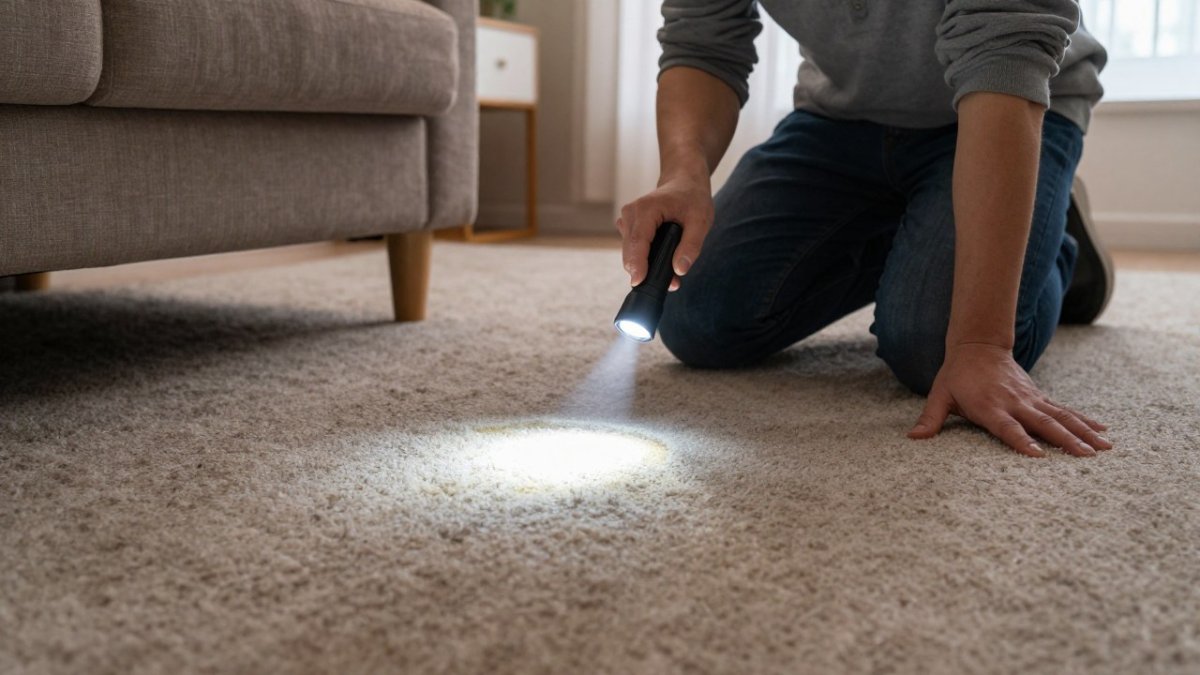
A UV blacklight is the most reliable DIY tool for finding dried urine. Urine salts glow under UV light. Here is how to use one:
- Wait until the room is dark. Close blinds and turn off overhead lights.
- Sweep the blacklight slowly, holding it a few inches above the carpet and moving in overlapping passes.
- Mark each glowing spot with painter's tape so you can treat them in one session.
- Get low and sniff near baseboards, furniture legs, and stair treads, where urine tends to pool.
Watch out: a blacklight can also light up food spills, detergent residue, and some carpet dyes. Confirm each spot with your nose before treating it, and treat only the confirmed areas.
Inspecting Beyond the Surface
Visual inspection has real limits. Urine wicks outward at the base of the carpet, so the visible spot is usually smaller than the soaked area underneath. Work through these checks in order:
- Walk the perimeter. Urine often lands against baseboards, behind furniture, and at the top of stair treads where pets mark.
- Check the tack strip. Pull up a small corner of carpet near a suspect spot and look at the tack strip and the edge of the padding. Dark, stiff, or crumbly padding is a sign the contamination reached below the fibers.
- Smell the padding, not the carpet. Press a clean white towel into the spot, then smell the towel. If the towel picks up odor, the contamination is deeper than the surface.
- Map the spots. Sketch the room and number each confirmed spot. Treating in one pass, from the outside of each spot inward, keeps you from spreading residue.
When to Stop Looking and Start Treating
If the blacklight and sniff test turn up more than a few spots, or if the odor returns within a day of cleaning, the contamination is likely in the padding. At that point, stop adding surface treatments and move to the padding and subfloor steps below. Repeatedly wetting the same area without extracting it can push residue deeper and make the odor harder to remove.
How to Remove Old Pet Odors from Carpet with Vinegar
Vinegar is a mild acid that helps neutralize odor and lift residue. It works best on fresh or light odors, not deep, old contamination. Here is the standard method:
- Mix one part white vinegar with one part water in a spray bottle.
- Test in a hidden spot first to check colorfastness.
- Spray the spot lightly. Do not soak it.
- Let it dwell for 5-10 minutes.
- Blot with a clean towel, pressing down hard.
- Rinse with clean water and blot again.
- Air dry with a fan.
A common mistake is pouring vinegar directly on the carpet. That pushes liquid deeper into the padding. Light misting is enough.
Vinegar is a mild acid that helps neutralize odor and lift residue, and it works best on fresh or light odors rather than deep, old contamination.
| Step | What to do | Time or frequency |
|---|---|---|
| Mix | One part white vinegar with one part water in a spray bottle | Once per session |
| Test | Check colorfastness in a hidden spot first | Before treating |
| Apply | Spray the spot lightly; do not soak it | Once per spot |
| Dwell | Let the vinegar sit on the spot | 5-10 minutes |
| Blot | Press down hard with a clean towel | After dwell |
| Rinse | Rinse with clean water and blot again | After blotting |
| Dry | Air dry with a fan | Until fully dry |
How to Remove Old Pet Odors from Carpet with Baking Soda
Baking soda absorbs moisture and odor, but it does not break down uric acid. Treat it as a helper, not a cure. Use it after a vinegar or enzyme treatment has dried.
Follow these steps:
- Sprinkle a thin layer of baking soda over the dry spot.
- Let it sit for several hours, or overnight.
- Vacuum it up with a strong vacuum.
- Repeat if the smell fades but does not disappear.
You can also make a paste with baking soda and water for set-in stains. Apply it, let it dry, then vacuum. Keep the paste off wool and delicate carpets unless you test first.
Enzyme Cleaner for Old Pet Urine in Carpet
An enzyme cleaner is a cleaning solution that uses live enzymes to break down uric acid crystals at the source. It is the most effective DIY option for old pet urine in carpet. The enzymes eat the residue that causes the smell, rather than covering it up.
Dwell Time, Soaking, and Extraction
Most enzyme cleaners fail because people rush them. The label always gives a dwell time, and it matters. Enzymes need time to work.
- Saturate, do not mist. The cleaner must reach the depth the urine reached.
- Cover the spot. Plastic wrap keeps the area damp so the enzymes stay active.
- Wait the full dwell time. This is often several hours.
- Blot and extract. Press out as much liquid as you can with towels, then use a wet vacuum if you have one.
- Let it air dry completely. Odor can linger while the carpet is damp, so judge the result only after it dries.
Watch out: do not use a steam cleaner on urine spots. The Humane World for Animals guidance on pet stains advises against steam cleaning urine, and heat can set the odor into the fibers.
Cleaning Carpet Padding and Subfloor
If the smell survives enzyme treatment, the contamination is likely in the padding or subfloor. No amount of surface cleaning will fix that, because the odor source sits below the fibers you can reach.
Pull Back the Carpet and Assess the Padding
Work carefully so the carpet can be reused:
- Pull the carpet loose from the tack strip at the nearest wall or doorway using a pry bar or stiff putty knife.
- Fold the carpet back without creasing it sharply.
- Inspect the padding directly under the worst spot. Look for dark staining, stiffness, or a crumbly texture.
- Smell the padding. If it carries odor, surface cleaning will not reach it.
Padding that is soaked, compressed, or crumbly usually needs replacing. Padding is inexpensive and easy to cut out, and a patch is far cheaper than replacing the whole room.
Clean and Seal the Subfloor
If urine reached the subfloor, treat it before putting anything back:
- Clean the surface. Wipe the subfloor with a damp cloth and a mild cleaner, then let it dry completely.
- Treat residual odor. Apply an enzyme cleaner to the subfloor and allow the full dwell time on the label.
- Seal it. Once dry, apply a stain-blocking sealer made for subfloors. The sealer keeps residual odor from wicking back up into new padding.
- Check for damage. Soft, swollen, or delaminating subfloor material may need replacement rather than sealing.
Watch out: do not mix cleaning products on the subfloor. Never combine bleach with ammonia-containing cleaners, and ventilate the room while any sealer or cleaner is drying.
Replace the Padding and Reset the Carpet
- Cut a new piece of padding to fit the removed section, matching the thickness of the existing padding.
- Staple or adhere the new padding in place.
- Stretch the carpet back over the tack strip and trim any loose edges.
- Vacuum and let the area dry fully before judging the result.
When Replacement Is the Honest Answer
If the backing of the carpet is degraded, if the padding under a large area is saturated, or if the odor returns after two proper enzyme treatments and a padding replacement, carpet replacement may be the only reliable fix. A professional assessment can confirm whether the carpet is salvageable before you spend more on treatments.
Professional Carpet Cleaning for Pet Odor Removal
Some odors are beyond DIY. Deep contamination, years of accidents, or urine that reached the subfloor usually need professional cleaning for pet odor removal. Professional equipment can extract more liquid than many rented machines, and professionals can work on padding and subfloor when needed.
Before you hire anyone, use this checklist:
- Ask how they locate hidden spots
- Ask whether they treat padding and subfloor
- Ask what happens if the smell returns
- Check reviews from pet owners
- Confirm drying time and method
If you are still comparing companies, our guide on how to find carpet cleaners close to me you can trust walks through the questions that matter. You can also read alternatives to Stanley Steemer for cleaner carpets if you are weighing a big-name chain against a local provider.
One more thing worth knowing: a carpet that has been soaked and re-soaked for years may be past saving. If the backing is degraded, carpet replacement is the honest answer.
When to Call Wilson for Pet Odor Removal
Consider a professional when the smell returns after repeated enzyme treatments, when the padding is soaked, or when the odor covers a large area. Those cases often need extraction work that DIY tools cannot handle.
Wilson Carpet & Air Duct Cleaning, LLC offers professional carpet cleaning with steam and low-moisture methods and fast drying times. Our team can help locate hidden spots and treat the carpet and padding, and we offer indoor air quality testing. If you want to talk through your situation first, contact us with questions. Ready to schedule? Book an appointment and we will take it from there.
Frequently Asked Questions
How do you find the source of an old pet odor in carpet?
Use a UV blacklight in a darkened room; dried urine fluoresces yellowish-green. Mark each spot with painter's tape, then press a clean white towel into the area and sniff to confirm. Check along baseboards, under furniture, and near doorways where pets frequently mark. If the carpet surface looks clean but the smell persists, the contamination may be in the padding or subfloor, which requires lifting the carpet edge to inspect.
Can vinegar remove old pet odors from carpet?
White vinegar can neutralize some surface odor and help lift residue, but it does not break down uric acid crystals trapped in padding. For old pet odors, vinegar works best as a pre-treatment before an enzyme cleaner. Mix equal parts white vinegar and water, apply lightly, blot, and let dry. Always test in a hidden spot first to check colorfastness, and never saturate the carpet because excess moisture can damage the backing and subfloor.
Will urine smell in carpet eventually go away on its own?
No. Uric acid crystals bond to carpet fibers and padding and reactivate in humid conditions, so the smell often returns stronger over time. Without removal, the residue continues to attract pets to the same spot. A repeat treatment with an enzyme cleaner or professional extraction is usually needed to break down the crystals and remove the odor-causing residue.
When should you call a professional carpet cleaner for pet odors?
Call a professional when the odor returns after two or three DIY treatments, when the stain covers a large area, or when the smell comes from padding or subfloor. Wilson Carpet & Air Duct Cleaning, LLC offers steam and low-moisture cleaning with fast drying times; call for an assessment of your carpet's condition.
Pet odor that keeps coming back is a sign the source was never reached. Let Wilson Carpet & Air Duct Cleaning, LLC find it, treat it, and get your rooms smelling clean again. Call us today to set up your visit.