 How-to
How to Clean Upholstery Without Soaking the Cushions
Last Updated: November 8, 2026
Quick Summary
To clean upholstery without soaking the cushions, match your method to the fabric code on the tag first, then work with as little moisture as possible by vacuuming, blotting with a barely damp cloth, and air-drying fast with airflow. Spray cleaner onto your cloth rather than the sofa, and never put the cushion core in a washing machine.
- W means water-based cleaners are safe, S means solvent only, WS means either, and X means vacuum only.
- For W fabrics, use about 1 teaspoon clear dish soap per 2 cups water and apply only the suds.
- Blot stains by pressing straight down instead of rubbing, which spreads the stain and roughs the fabric.
- A fan on medium for 2 to 4 hours usually dries surface-damp fabric; avoid direct sun and high heat.
- Call a professional when the fabric code is S or X, stains keep returning, or cushions smell musty inside.
Table of Contents
- Step 1: Check the Fabric Code and Prep the Sofa
- How to Clean Fabric Sofa by Hand Without Soaking It
- What Is the Best Homemade Upholstery Cleaner?
- How to Clean Couch Cushions Without a Washing Machine
- How to Deep Clean Fabric Sofa at Home and Dry It Fast
- When to Call Wilson for Professional Upholstery Cleaning
- Frequently Asked Questions
Step 1: Check the Fabric Code and Prep the Sofa
You can clean upholstery without soaking the cushions by matching your method to the fabric code first, then working with as little moisture as possible. Before you touch a drop of cleaner, find the tag under the seat cushion or behind the back panel.
That tag decides everything: whether water is safe, whether solvent is safe, or whether you should only vacuum. Skip it and you risk a water ring or a faded patch that never comes out.
Here is how we would prep the sofa:
- Remove all removable cushions and covers.
- Vacuum both sides of every cushion with the brush attachment.
- Note the care tag code letter.
- Test any cleaner on a hidden spot first.
If you cannot find a tag, treat the fabric as delicate. That means less water, not more.
Decoding W, S, WS, and X Cleaning Codes
W means water-based cleaners are safe. S means solvent-based cleaner only, no water. WS means either one works. X means vacuum only, no liquid at all.
Here is the quick reference we use on the job:
| Code | Safe Cleaner | Avoid | Best Method |
|---|---|---|---|
| W | Water-based foam | Strong solvents | Damp cloth, light foam |
| S | Solvent-based cleaner | Water, steam | Dry solvent, air-dry |
| WS | Water or solvent | Over-wetting | Either, applied sparingly |
| X | None, vacuum only | All liquids | Brush and vacuum |
Fabric care guidance from Room & Board's upholstery cleaning guide splits care into fabric, spot, and general cleaning for exactly this reason. A water-based foam that saves one sofa can stain another.
How to Clean Fabric Sofa by Hand Without Soaking It
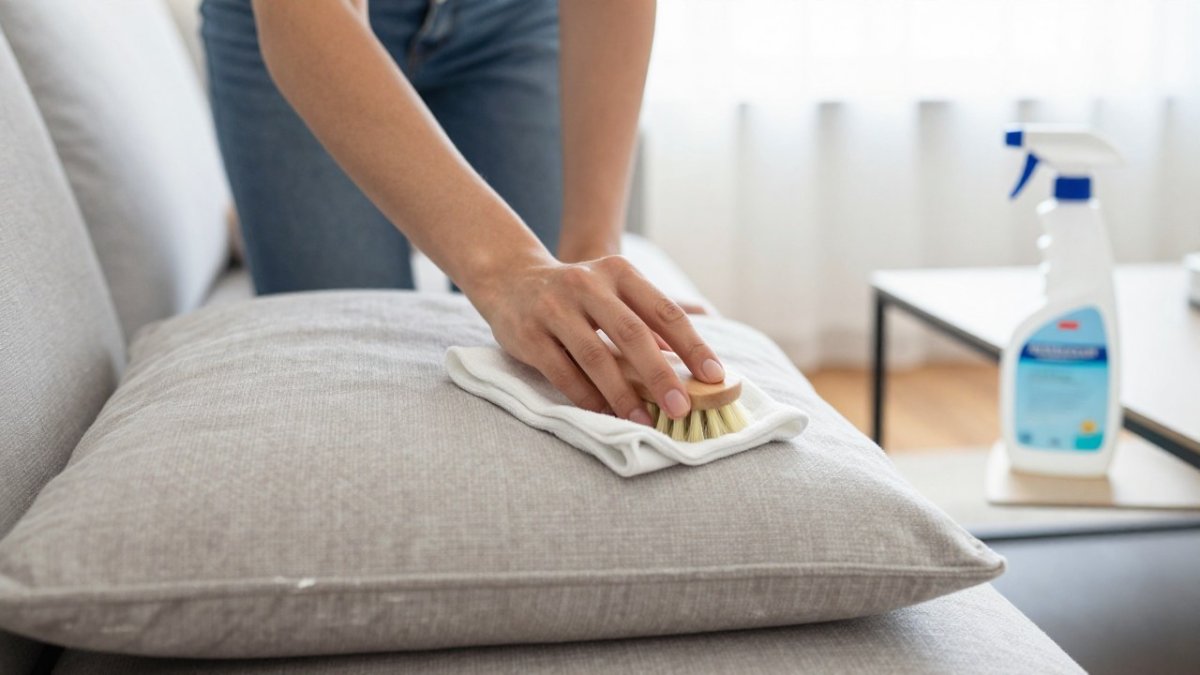
Cleaning a fabric sofa by hand without soaking it comes down to three moves: vacuum, blot, and air-dry. The goal is to lift dirt and stains with the least moisture possible, then dry fast.
Most people over-wet the fabric and then scrub. That pushes dirt deeper and leaves a ring. The low-moisture method does the opposite.
Vacuum, Blot, and Air-Dry: The Low-Moisture Sequence
- Vacuum first. Run the brush attachment over the whole sofa, including seams and under the cushions. Loose debris and dust cause most of the dull look.
- Spot-test. Apply a little cleaner to a hidden area. Wait a few minutes and check for color change.
- Apply sparingly. Spray cleaner onto your cloth, not the sofa. A damp cloth beats a soaked one.
- Blot, do not rub. Press straight down and lift. Rubbing spreads the stain and roughs up the fabric.
- Rinse with a clean damp cloth. Wipe away leftover cleaner so it does not attract new dirt.
- Air-dry with airflow. Open windows or aim a fan at the cushions. Fast drying prevents mildew and water rings.
If the smell is the real problem, our guide on removing old pet odors from carpet covers the deeper odor-fighting steps.
What Is the Best Homemade Upholstery Cleaner?
The best homemade upholstery cleaner depends on your fabric code, not a single universal recipe. A mix safe on W-coded cotton can leave a ring on S-coded microfiber or damage delicate X-coded fabric.
Here is how we match homemade cleaners to codes:
| Fabric Code | Safe Homemade Option | Avoid | Application Note |
|---|---|---|---|
| W | Mild dish soap and warm water (about 1 teaspoon clear soap per 2 cups water) | Strong solvents, bleach | Whip to suds, use only the foam on a barely damp white cloth |
| S | Do not use water-based homemade mixes; use a solvent-based upholstery cleaner labeled for S codes | Water, vinegar, steam | Apply solvent to a cloth, not the fabric, and air-dry |
| WS | Either mild soap solution or solvent-based cleaner | Over-wetting | Choose the milder option first and test |
| X | None, vacuum only | All liquids, including vinegar and baking soda | Brush and vacuum only |
For W and WS fabrics, mild detergent and warm water is the workhorse. Use clear, dye-free dish soap or delicates laundry detergent in warm water, diluted lightly.
Vinegar and water can help with light odors on W-coded fabrics when diluted. Never use vinegar on S-coded fabrics or on silk or wool without testing, since the acid can affect dyes.
Never mix vinegar and baking soda in a spray bottle, they neutralize each other and the fizzing pushes residue deeper. Never mix bleach with vinegar or ammonia; the fumes are hazardous.
A store-bought fabric-safe cleaner labeled for upholstery is often the safer bet when unsure.
How to Clean Couch Cushions Without a Washing Machine
You can clean couch cushions without a washing machine by spot-cleaning the surface and keeping the cushion core dry. Only removable covers should ever go near water, and only if the tag allows it.
For non-removable cushions, follow the blot-and-air-dry method above. For removable covers, check the care label first; if it says machine wash, use cold water on a gentle cycle, then air-dry.
A few rules we follow:
- Never put the cushion core in a machine, it holds water and can grow mildew inside.
- Wash covers one at a time so colors stay matched.
- Air-dry covers flat, away from direct heat.
- Re-fluff cushions once fully dry.
If a cover is not colorfast, hand-wash it cold and blot dry, testing a hidden seam first for color transfer.
How to Deep Clean Fabric Sofa at Home and Dry It Fast
Deep cleaning a fabric sofa at home means a full vacuum, a targeted spot clean, and a fast dry with good airflow.
A genuinely low-moisture method keeps liquid on the surface: dampen the fabric, don't soak it.
To dry fast and prevent water rings:
- Blot immediately. Press a dry white towel onto the area and replace it when damp.
- Prop up the cushions. Stand them on edge so air reaches both sides; if not removable, aim a fan across the seat and under the edges.
- Use airflow, not heat. A box or oscillating fan on medium for 2-4 hours usually dries surface-damp fabric. Avoid direct sun and high-heat hair dryers.
- Run a dehumidifier or AC. Lower indoor humidity helps moisture leave the cushions.
- Check seams and welts. They hold moisture longest, press a dry towel along them and let airflow reach them.
Watch out: if the fabric still feels damp after a day, stop adding water, increase airflow, and consider calling a professional, since trapped moisture can lead to mildew inside the cushion core.
Signs of too much moisture include a dark tide-line ring, a musty smell after drying, or a cool, damp feel when you press the cushion.
For a deeper clean on W- or WS-coded fabric, use a low-moisture foam cleaner: apply foam to a cloth, work it in small circles, then blot immediately with a dry towel. Do not saturate.
When to Call Wilson for Professional Upholstery Cleaning
Call a professional when the fabric code is S or X, when stains keep coming back, or when the cushions smell musty inside. Some jobs need low-moisture equipment and know-how that DIY cannot match.
At Wilson Carpet & Air Duct Cleaning, LLC, we clean upholstery with both steam and low-moisture methods.
Call us when:
- The care tag says solvent only and you are unsure.
- A stain has set for weeks.
- Odors come from deep in the cushion.
- You want the whole set cleaned before guests arrive.
You can see our upholstery cleaning service or contact us to request a quote. We serve homeowners and property managers across Ocean, Monmouth, Middlesex, and Burlington counties, including Toms River, New Jersey.
Your sofa should not have to choose between clean and dry. If a stain, a smell, or a delicate fabric has you stuck, let our team handle it with the right method for your cushions.
Frequently Asked Questions
How do you clean couch cushions that aren't washable?
Clean non-removable cushions in place using a low-moisture method. Vacuum both sides with an upholstery attachment, then spot-treat stains with a fabric-safe cleaner applied to a cloth rather than sprayed directly. Blot instead of scrubbing, and keep the cushion core dry. Check the fabric cleaning code first: W codes accept water-based cleaners, S codes need solvent-based products, and X codes should only be vacuumed. Run a patch test on a hidden area to confirm colorfastness before treating the whole cushion.
Is Dawn dish soap safe to use on upholstery?
A few drops of mild dish soap in warm water can lift light grease and food stains from many W-coded fabrics, but it is not safe for every material. Dawn and similar degreasers can leave residue that attracts dirt or dulls color on delicate weaves. Always dilute it heavily, test on an inconspicuous spot first, and rinse with a clean damp cloth. For S-coded or vintage fabrics, use a solvent-based cleaner instead. If you are unsure of the fabric code, skip the dish soap.
How do you dry upholstery quickly after spot-cleaning?
Blot away as much moisture as possible with dry towels, then aim a fan at the cushion and open windows or run a dehumidifier. Avoid direct heat from hair dryers or space heaters, which can set stains and damage fibers. Most spot-cleaned areas dry in a few hours; deeper cleanings may take longer. To prevent mildew and water rings, keep cushions elevated and rotate them so air reaches all sides. If the cushion core feels damp after 24 hours, stop using the sofa until it dries fully.