 ultimate-guide
Signs Your Home's Air System Needs Professional Attention: A Homeowner's Guide
Last Updated: October 28, 2026
Quick Summary
Signs your air system needs professional attention include dust streaks radiating from vents, a musty smell that returns when the blower runs, weak or uneven airflow room to room, filters that clog in weeks instead of months, and visible pest activity or mold on system surfaces. Rule out a loaded filter first, since it mimics every one of these symptoms.
- Change the filter and recheck symptoms in two weeks before concluding the air system is the problem.
- A tissue held against each supply vent reveals which rooms have weak airflow.
- A filter that loads in three weeks instead of three months points to debris entering the return side.
- Rodent droppings, chewed insulation, or visible mold on duct surfaces justify cleaning.
- Ask whether the air handler, blower, and coil are included in the written scope.
Table of Contents
- Why Air System Maintenance Gets Recommended So Often
- 1. Dust Coming From Air Vents and Surfaces That Won't Stay Clean
- 2. A Musty Smell From Air Vents That Returns After You Clean
- 3. Weak, Uneven, or Reduced Airflow Room to Room
- 4. Filters That Clog Fast and Visible Debris Around Vents
- 5. Allergy Symptoms, Pest Activity, and Moisture You Can't Ignore
- How to Check Air Ducts Yourself Before You Call Anyone
- How Long Does Duct Cleaning Take, and What Happens During a Visit
- When Cleaning Is Warranted, When It Isn't, and How to Avoid a Bad Estimate
- Book an Inspection and Get a Straight Answer
- Frequently Asked Questions
Why Air System Maintenance Gets Recommended So Often
The phrase "signs your air system needs professional attention" gets searched heavily every fall, and for good reason: it is one of the few home maintenance questions where the honest answer is more complicated than the sales pitch. At Professional Residential and Commercial Carpet Cleaning, Dryer Vent Cleaning, Air Duct Cleaning and Pressure Washing Services, we get asked about air systems constantly, and we would rather you understand the evidence than trust a door hanger.
Here is the uncomfortable truth most guides skip: the U.S. Environmental Protection Agency's guidance on residential air system cleaning states plainly that air system cleaning has not been shown to prevent health problems, and that studies have not conclusively demonstrated that dust inside ducts raises particle levels in living spaces.
Below, we walk through the five categories of evidence worth acting on, how to check your own system before calling anyone, what a real visit involves, and when to say no.
1. Dust Coming From Air Vents and Surfaces That Won't Stay Clean
Dust is the most cited sign, and also the most misread. Every home has dust; the question is whether your HVAC system is redistributing it.
Watch for these patterns:
- Dust streaks radiating from supply vents onto ceilings or walls
- Dark rings around vent covers that reappear within days of wiping
- A fine film settling on furniture faster in rooms closest to vents
One caveat matters here. A dirty filter, a leaky return duct in an attic, or a house near a gravel road will produce the same symptoms. Before you conclude the air system is the problem, change the filter and recheck in two weeks.
2. A Musty Smell From Air Vents That Returns After You Clean
A musty smell from air vents is the sign we take most seriously, because odor travels with moisture. When the blower runs and the smell strengthens, the source is usually inside the system rather than in the room.
Common culprits include:
- Condensate from the air conditioner's evaporator coil draining poorly
- Insulated duct liner that stayed damp after a humid stretch
- A return plenum pulling air from a crawlspace or basement
If the smell fades when the system is off and returns within minutes of startup, that points to the air system or the air handler. If it lingers constantly, check for a plumbing leak or roof issue first.
3. Weak, Uneven, or Reduced Airflow Room to Room
Reduced airflow is often an air system problem, but it is just as often a damper, a crushed flex run, or a filter that has not been changed since spring.
Run this simple test. Hold a tissue against each supply vent while the fan runs on its normal setting. Compare rooms.
Uneven airflow across a whole floor usually points to a design or balancing issue rather than accumulated debris.
4. Filters That Clog Fast and Visible Debris Around Vents
Filter replacement frequency is one of the most honest indicators you have.
Look for visible debris too: construction dust after a renovation, drywall grit, insulation fibers, or pet dander packed against the return grille.
A dirty filter also strains the blower. If you notice the system short-cycling or the motor sounding labored, address filtration first. Cleaning the air system without fixing the filtration source just resets the clock.
5. Allergy Symptoms, Pest Activity, and Moisture You Can't Ignore
Worsening allergy or asthma symptoms after the heat comes on deserve attention, though the EPA's position is clear that air system cleaning has not been proven to reduce health symptoms.
The stronger signals in this category are physical:
- Droppings, nesting material, or chewed air system insulation near the air handler
- Scratch marks or gaps where a pest entered the return system
- Visible mold growth or dark staining on air system surfaces or the coil cabinet
Rodent activity inside the air system is a genuine reason to act, both for air quality and because chewed materials can compromise the system. Moisture plus organic dust is the combination that supports microbial growth.
How to Check Air Ducts Yourself Before You Call Anyone
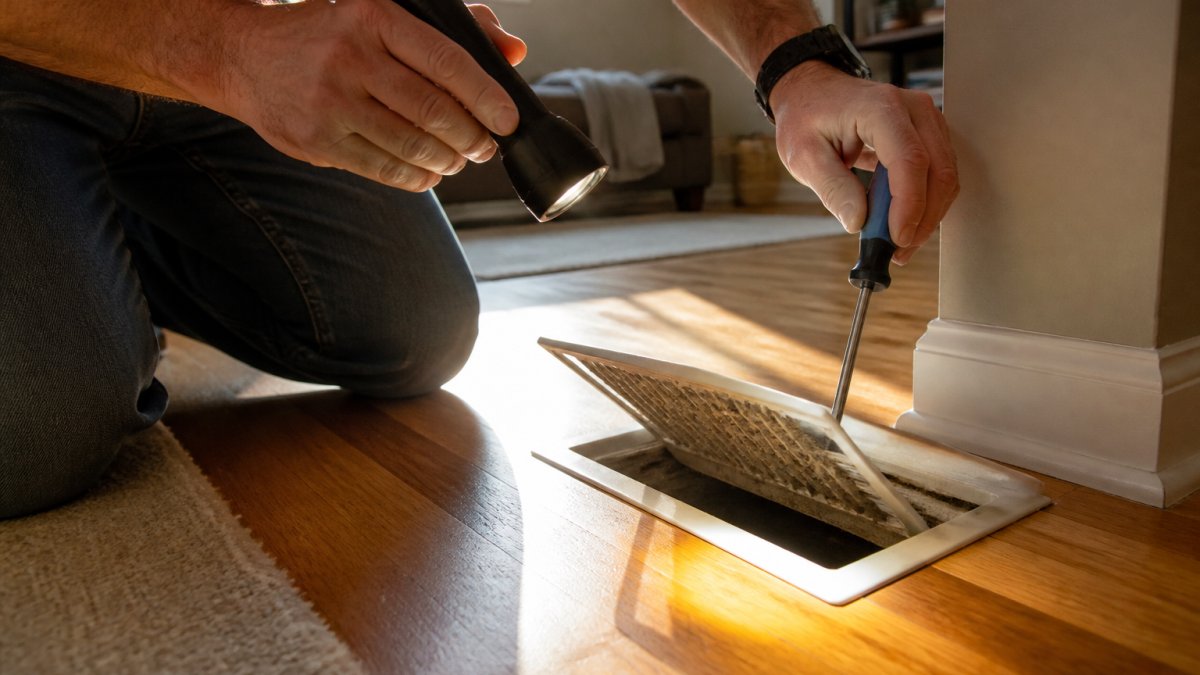
A homeowner can gather useful evidence in about twenty minutes with a flashlight, a screwdriver, and a notebook.
Step 1: Rule out the filter before anything else
Pull the filter and hold it up to a bright window. If you cannot see light through it, the filter is loaded and is the most likely cause of weak airflow and fast-returning dust. Note the MERV rating printed on the frame. A MERV 13 filter that was crammed into a slot designed for MERV 8 will choke airflow on its own, and no amount of air system work will fix that.
Step 2: Test airflow room by room
Hold a tissue against each supply vent with the fan running on its normal setting. Compare rooms. A vent that barely moves the tissue while others push it steadily suggests a blockage, a closed damper, a crushed flex run, or a disconnected branch serving that room. Write down which rooms are weak and whether the weakness is one room, one side of the house, or the whole floor.
Step 3: Check the return side for leaks and outside air
Return ducts in attics and crawlspaces are the most common place for a system to pull in unconditioned air, insulation fibers, and crawlspace moisture. With the fan running, run your hand along the seams of accessible return duct and feel for suction. A leaky return in a hot attic will pull in dust and humidity all summer and can mimic every symptom on this list.
Step 4: Look for moisture before you look for mold
Open the air handler cabinet if it is safely accessible and look at the drain pan and the evaporator coil. Standing water, rust trails, or a slimy film on the coil point to a drainage or humidity problem that will keep coming back regardless of what happens upstream. A musty smell that appears only when the system runs is usually moisture at the coil or in duct liner, not dust.
Step 5: Photograph what is actually inside
Remove two or three supply vent covers and one return grille. Photograph what you see with the flashlight angled along the air system wall rather than straight in, side lighting shows buildup that a direct beam hides. Note the color and texture: dry gray dust is ordinary; dark staining, fuzzy growth, or droppings are not. Do not reach into the air system beyond the boot.
Step 6: Write down the pattern, not just the symptom
Before you call anyone, write a short log: when the symptom appears (fan on, fan off, heat, cooling), which rooms are affected, when the filter was last changed, and whether anything changed recently, a renovation, a new pet, a roof repair, a humid stretch. That log is worth more than any phone description, and it lets a technician tell you within minutes whether the problem is likely in the air system or somewhere else entirely.
For a deeper, balanced look at whether the work is necessary at all, see our guide on whether air system cleaning is really necessary.
How Long Does Duct Cleaning Take, and What Happens During a Visit
Most residential visits run two to four hours depending on the number of vents, the system layout, and how accessible the air system is. A single-story home with eight to twelve vents typically sits at the shorter end; a two-story with a finished basement, multiple zones, and a long trunk line can run longer. If a provider quotes a fixed time before seeing the system, that is a sign the scope was never really assessed.
A legitimate visit follows a recognizable sequence, and you should be able to watch each step happen.
1. Walkthrough and inspection before any equipment comes in
The technician should walk the house with you, confirm the symptoms you logged, and inspect the air handler, coil, drain pan, filter slot, and accessible air system runs. A real inspection includes a visual check of the return side for leaks and disconnected runs, a look at the coil for buildup, and, on better visits, a static pressure reading at the air handler to see whether the system is moving the air it was designed to move.
2. Containment and access
Before work begins, the system should be placed under negative pressure with a HEPA vacuum connected to the trunk line, and access holes should be cut at the trunk and at strategic branch points. Ask where the holes will go and how they will be sealed afterward. A provider who plans to cut without a resealing plan is leaving you with a leak.
3. Mechanical agitation, one zone at a time
Compressed air whips, rotary brushes, and manual agitation are used to loosen debris from air system walls while the vacuum pulls it out. The work should proceed zone by zone so that loosened debris does not migrate into cleaned sections. Ask whether the air handler and coil will be cleaned as part of the scope, many low bids skip them, which leaves the largest reservoir of buildup untouched.
4. Air handler, blower, and coil cabinet
The blower wheel, coil, and cabinet are where the most consequential buildup lives. A blower caked with dust moves less air and strains the motor; a fouled coil loses capacity and holds moisture. Confirm in writing that these components are included, not added later as an upsell.
5. HEPA vacuuming and resealing
After agitation, the work area should be HEPA-vacuumed and every access point sealed with foil tape, mastic, or a proper cap. Ask what will be used. A hole left covered with duct tape will fail within a season.
6. Before-and-after walkthrough with photos
Ask for photos of the access points, the trunk interior, and the coil before and after. A provider who cannot show you what came out is asking you to take a lot on faith. The walkthrough is also the right time to ask what caused the buildup, a leaky return, a missing filter gasket, a renovation, because fixing the source is what keeps the air system clean.
What to ask before you book
- Will the air handler, blower, and coil be cleaned, or only the air system runs?
- How will access holes be cut and resealed?
- Will you measure static pressure and show me the reading?
A provider who answers all five plainly is telling you something about how the visit will go.
When Cleaning Is Warranted, When It Isn't, and How to Avoid a Bad Estimate
Cleaning is warranted when you have documented pest activity, visible mold on system surfaces, a renovation that filled the air system with debris, or a system that has never been addressed after water intrusion.
Cleaning is usually unnecessary when the only complaint is ordinary household dust and the filter is being changed on schedule.
Watch out for the estimates that lead with a low headline number and add line items for sanitizing, sealing, and coil treatment once the crew is in the driveway.
Book an Inspection and Get a Straight Answer
If you have worked through the checklist and something still looks wrong, stop guessing. Our team inspects the system, shows you what we find, and tells you plainly whether the work is justified.
Get started with Professional Residential and Commercial Carpet Cleaning, Dryer Vent Cleaning, Air Duct Cleaning and Pressure Washing Services and get an honest assessment of your system before the heating season arrives.
Frequently Asked Questions
What are the signs your air ducts need professional cleaning?
The clearest signs include dust that settles again within days of cleaning, a musty smell that returns whenever the furnace or air conditioner runs, weak or uneven airflow between rooms, filters that clog far faster than usual, visible debris around supply and return vents, and pest droppings or chewed material inside the air system. Worsening allergy symptoms and moisture or suspected mold growth near HVAC equipment also point to a problem worth inspecting. One sign alone is a question mark; two or three together make a professional inspection worth scheduling.
How to check air ducts at home without special tools?
Start with a flashlight and your nose. Remove a supply vent cover and look inside the first stretch of air system for dust buildup, debris, or dark staining. Shine the light across the room with the system running to see how much dust is being pushed out. Check the air filter, note how dirty it is and when you last changed it, then compare airflow by holding a tissue against several vents. Finally, smell the air near return vents when the system starts. Anything that looks, smells, or feels wrong is worth writing down before you call.
Does homeowners insurance cover air duct cleaning?
Most standard homeowners policies do not cover routine air system cleaning because it counts as maintenance rather than a sudden covered loss. Coverage can apply when air systems are damaged by a covered event such as a fire, water damage, or a burst pipe, and some policies include limited coverage for mold remediation. Read your policy or call your agent and ask specifically about air system cleaning and remediation, and get any approval in writing before work begins so there is no surprise afterward.
How long does a full duct cleaning take?
For a typical single-family home, a full air system cleaning usually takes two to four hours depending on the number of vents, how accessible the air system is, and how much buildup is present. Larger homes, multiple HVAC systems, or heavy contamination push it toward the longer end. Commercial spaces and multi-unit rental turnovers take longer and are often scheduled in stages. Ask for a time estimate when you book, and clear access to vents and the air handler beforehand so the crew is not waiting on furniture.
Can dirty air ducts cause dust around the house?
They can contribute, but they are rarely the only cause. Dust in the air system gets pushed into rooms every time the system runs, which shows up as dust coming from air vents and settling on nearby surfaces. Before assuming air systems are the culprit, rule out a clogged filter, leaky return ducts, a humidifier, pets, and recent renovation work. If surfaces stay dusty within days of cleaning and the filter is fresh, air system inspection is a reasonable next step.
What are the downsides of duct cleaning?
The main downsides are cost, disruption, and the risk of hiring a provider who does a surface pass and calls it done. Poorly done cleaning can stir up debris without removing it, and some offers use scare tactics about health to push unnecessary work. The EPA notes air system cleaning has not been shown to prevent health problems, so treat health claims with skepticism and clean based on visible contamination, not fear. Ask what equipment is used, whether the air handler is included, and what verification you will get.